
The Gaze
Attention as Disciplined Openness

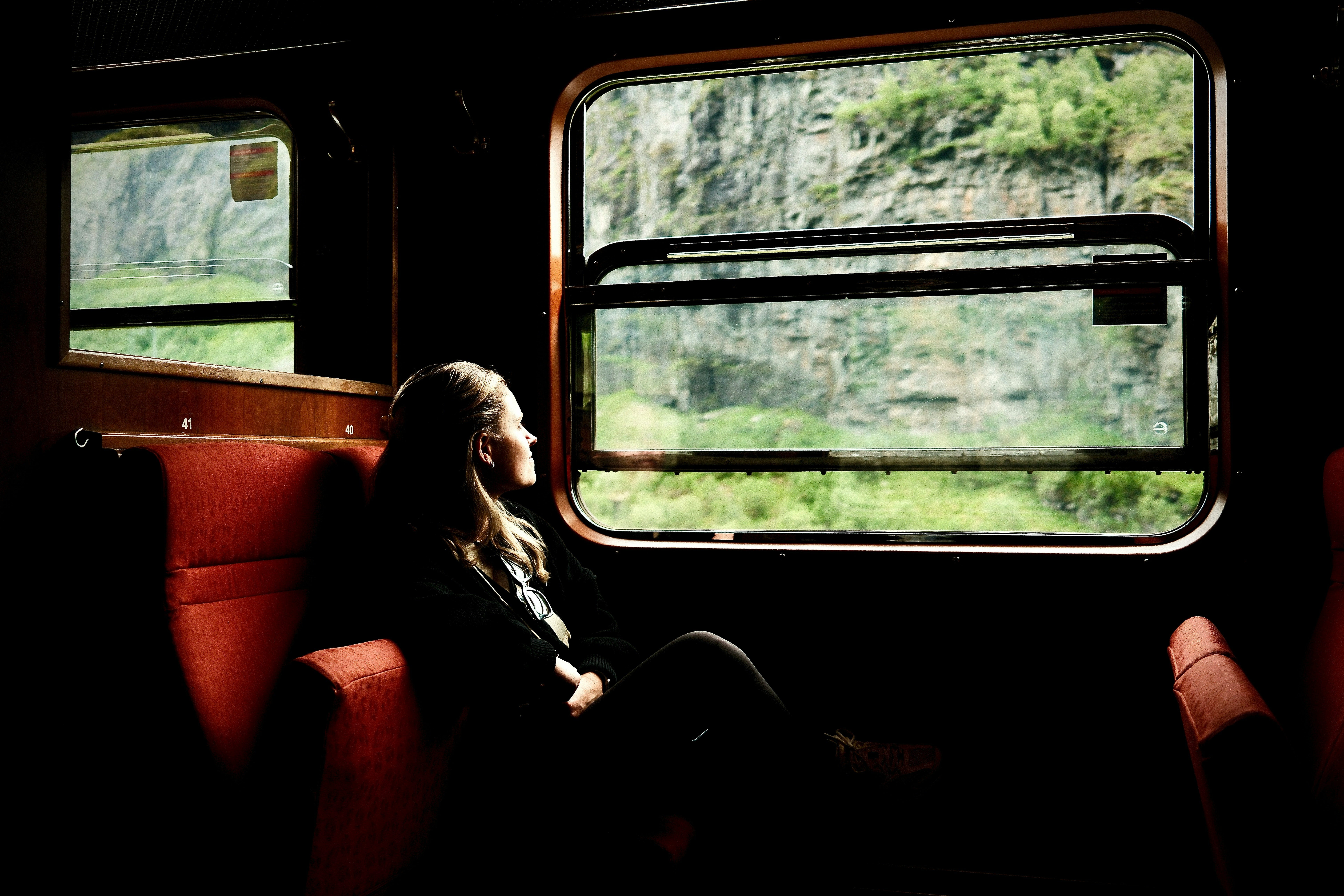
You enter a train carriage, scan who is inside, and look for a spot to sit. It is a quiet afternoon not long before the end of the working day and there are plenty of free seats. You sit next to a window with two free seats beside, in front and behind you.
For a moment, it feels like you are alone. The rhythm of the clattering of the wheels on the tracks settles into the background, and you look out of the window thinking about your day as the train passes row-after-row of houses.
The train then arrives at the next stop and the doors alight. You notice someone getting on your carriage. You don’t know who they are but something registers. You hope they don’t sit near you. Your eyes fixate on them for a brief moment, judging their posture, movement and where they may sit. They then take a seat a few rows in front of you.
A few moments later two people a similar age to you walk through from the connecting carriage. This time they take the seat directly behind you. Your body adjusts reflexively. You can register their presence, their conversation, almost like you are a casual observer entering their world. They do not break your thoughts entirely, but disturb them. You become more aware of your body position and reactions. You listen to their conversation, in part, even though you do not want to.
The train stops again at the next station. This time two teenagers enter your carriage, and one of them you recognise as a friend’s daughter. You intentionally shift your eyes downwards, hoping she does not notice you, but to no avail. Suddenly you are more aware of how someone you know interprets your posture. You compare back to the context you know her, to your friend, and gather data. Quickly, you shift the direction of your neck further to the left and look down at the tracks, trying to focus back on its sound, although you have lost your previous train-of-thought.
The French intellectual Jean-Paul Sartre, writing in the middle of the 20th century, termed the condition of the presence, or potential, of another person entering our physical space as The Gaze. It introduces a change in our internal state, transforming us from being immersed in the world as an individual, into an object which can be perceived, interpreted, and judged.
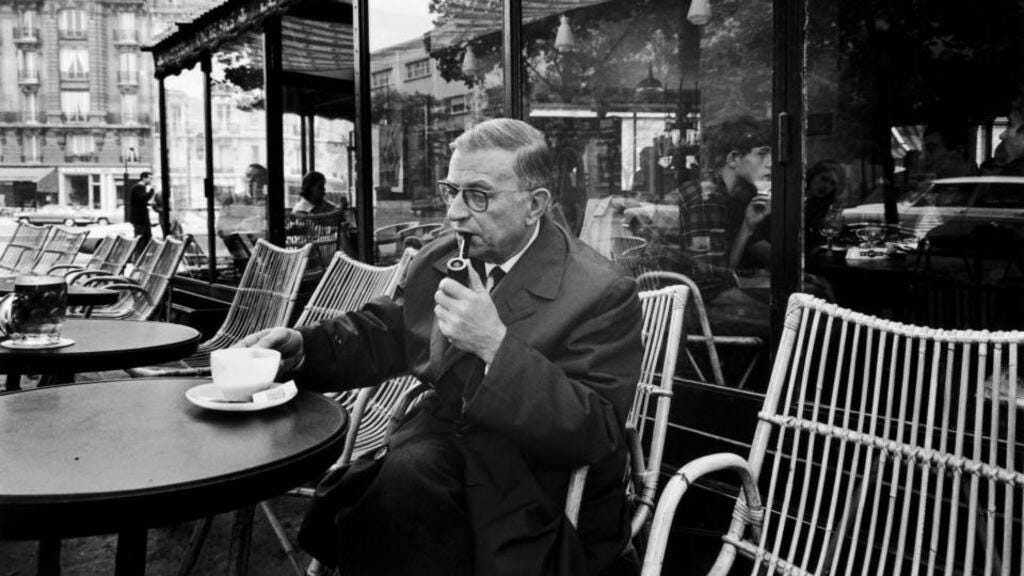
Somewhere deep in our subconscious, awareness turns inward, and we begin to see our actions mediated through how we might appear to another human subject. Our consciousness in the presence of others, like travelling on the train, then becomes an intuitive process of weighing possibilities. These possibilities include millions of pre-coded experiences, interpretations of social norms and an internal running monologue on how we may be seen in each space we enter.
Each time we enter a new space (relational, social, institutional or digital) we intuitively situate ourselves. Imagine a soccer player who traces thousands of game scenarios stored in their long-term memory before deciding on a perceptual-motor movement which seems effortless. We too reflexively scan our environment for tone, body language and subtle cues to guide our internal response to the gaze. Our senses are constantly receiving information, comparing, interpreting and then responding.
In these spaces we become aware of ourselves as something that can be evaluated within a field of meanings we do not fully control. It alters us, even if we think we are immune. For Sartre, he believed that the gaze was not only something external which we respond to, but also internalised, shaping not just how we act, but how we come to understand what it is to act at all.
We are only able to experience what we have already pre-defined as the projection of confidence, competence, failure, or the meaning behind phrases and tone. I have discussed this theory of language in my earlier essay, The Games We Play with Language. Our experiences are embedded into us over time through history, our family, education, the media and digital environments. The rules are inherited, but they are not static. They shift; sometimes slowly, sometimes faster.
If our response to the gaze of others in our space is filtered through these normative expectations of the self (us), then we can gradually alignment with what is most recognisable and validated. This is not necessarily a negative. All of us do this on some level. What I am questioning is that when left unexamined, there may be a risk lurching underneath the surface.
The constant need to respond, perform, and adapt to new streams of attention (physical and digital) can lead to what I call a diffusion of thought, where we may lack the ability to fully critique our own behaviours. We become attuned to our environment and respond as such, but the feedback loop for self-evaluation is missing information.
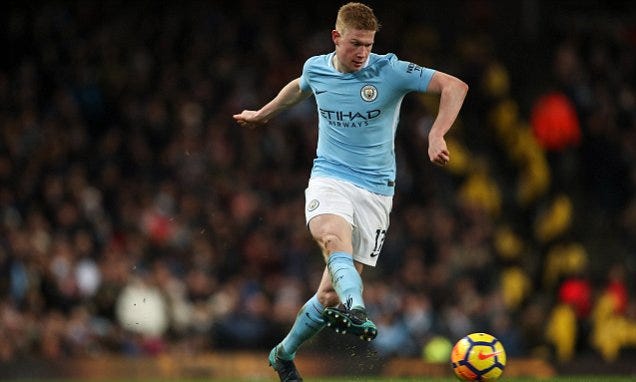
An elite soccer player like Kevin De Bruyne learns how to scan their surroundings, filtering out irrelevant information, relegating the crowd to the peripheral and learning from prior mistakes. They study their actions after the game through reflection and analysis with an open-mind, to take with him something for the next game or moment. If the soccer player’s consciousness becomes drawn outward, interrupting their inner experience and captured by the presence of others, this affects how they make decisions in the moment.
Attention as Disciplined Openness
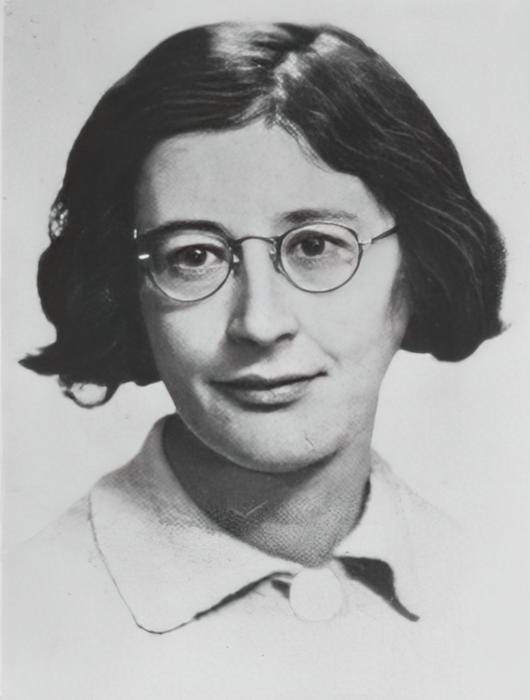
The teacher, writer and French resistance fighter Simone Weil gives us and the soccer player a template to work with. She did not view attention as concentration in the conventional sense, but rather a form of disciplined openness. For Weil, to attend, in her terms, is not to strain toward something, nor to perform engagement, but to hold the mind in a state of quiet suspension.
In one of her many essays, she writes about the conditions for attention:
‘Attention consists of suspending our thought, leaving it detached, empty, and ready to be penetrated by the object; it means holding in our minds, within reach of this thought, but on a lower level and not in contact with it, the diverse knowledge we have acquired which we are forced to make use of.’
This type of attention requires a different posture to the one adopted by the character on the train. Their attention was constantly interrupted. Not always broken, but redirected internally. They were pulled away to recalibrate themselves. Weil asks something else of us. It is to remain with the object of our attention, to resist being pulled away, yet holding our vast knowledge of prior experiences just beneath the surface, so as to not disrupt the naked truth of the experience.
What she means by holding our knowledge under the surface, is that true attention requires the discipline, willingness and humility to suspend the filtering of our own position relative to the object of our attention. This is a difficult concept to understand so I will refer back to my example of the soccer player. Weil considers full attention not as a passive process, but as a resistance. When Kevin De Bruyne scans the spaces in front and behind him, the movement of the ball, the position of the hips, the shifting position of the goalkeeper, he is not unaware of his prior experiences, the coach, the crowd, or how they are perceived as a subject. He is immersed in the now, in the unfiltered action, with the courage and humility to change his approach based on his vast knowledge which sits just under the surface of immediate perception.
What Weil asks of us is extraordinarily difficult, particularly in an age of constant distraction, opinion and movement. For her, to attend fully is to momentarily loosen the grip our preconceptions have on us, and to allow the truth to enter unobstructed. If you study her life, you will see someone who refused to sit in comfort. She was a genius who left the comfort of the classroom for factory floors, subjecting her body to exhaustion so that labour was not something she described, but something she embodied. Later, she fought in the Spanish Civil War, and refused to eat more than those suffering under French occupation by the Germans, allowing her beliefs to inhabit her body. Weil also always left open the possibility for her beliefs to change, which, for me, is the most humble of all virtues.
The Comfort of Predictability
As a person inhabiting shared spaces we are in constant negotiation between the relative comfort of predictable visibility and the risk of being seen differently. Uniformity in interpersonal settings can de-centre us as the individual with attention diffused and the gaze shared. Consider the uniforms we expect students, sporting teams, the armed forces or specific vocations to wear. As the field of possible judgment narrows, the self anticipates less how we are interpreted.
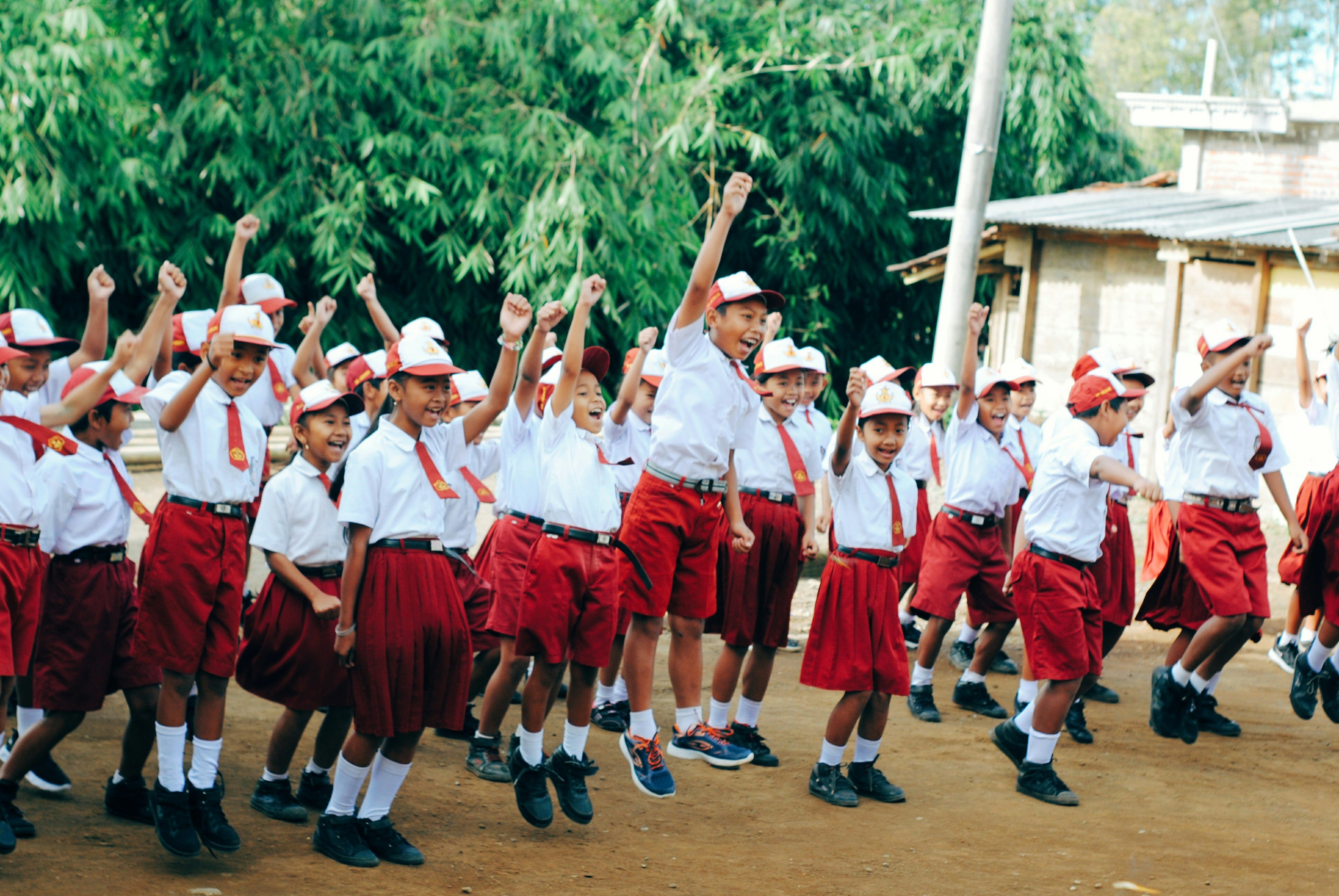
This is why we often feel more at ease in contexts of familiarity, even if it is shaping the limits of how we appear and act; for example an established friendship group, relationship or job. On the train the character felt less at ease when seeing their friend’s daughter, because the experience of strangers on the train was a more predictable environment for them.
It is not that uncertainty is something which should be eliminated. It is what creates the conditions for life; for movement, for encounter, for the possibility of being changed. It is where you can step into the unknown where both imagination and faith co-exist.
However, uncertainty is also the space where anxiety can emerge, as we turn inward and the openness of a situation can become a question of the self. It is not when we are open to the question of what is this?, but what am I within this?, or how am I being seen?, and what standard applies?
It is in these moments that our attention shifts, like the metaphor of the person on the train, toward an internalised projection of how we might appear. The gaze then is no longer simply present externally, it becomes absorbed. Anxiety can increase when the self turns inward and we look for certainty to close the gap. It is not caused by others in isolation, but by our relationship to what we might be.
This condition also exists in anticipation of our experiences, not only in the moments we experience them, causing what modern psychologists have categorised as social anxiety. In my earlier essay ‘The Paradox of Rationality’ I examined the recent Netflix documentary on the ‘manosphere’ phenomenon, which I feel connects to this very point. When uncertainty rises through emergent interpretations and shifts in collective moral frameworks, young people seek voices who offer them a path to certainty to reduce their anxiety. It is this gap between certainty and uncertainty which has enveloped so quickly since the turn of the millennium and the rise of the smartphone.
Awareness ≠ Paralysis
Awareness is not a reflection trap, nor the constant weighing of possibilities until action becomes impossible. True awareness does not freeze; it steadies and opens. It is the space where there is enough distance between perception and response, so that we are not immediately governed by how we will be seen. Just like the example of Kevin De Bruyne, full attention to the moment is clarifying. There is uncertainty, of course, but it allows for action to emerge with greater precision, not grounded in reaction; but through encountering what is in front of you.
The challenge for our future generations who are already immersed in a digital world, is not in resolving the tension immediately, nor endlessly questioning; but to remain within it for a moment longer. To hold space, not as detachment, but as a form of orientation, where they can begin to recognise what is happening around them before responding.
This requires the spaces to build deep-knowledge so that they can compare and contrast to memory stores. Importantly it is also for them to have the courage and patience to see without immediately seeing themselves being seen. It is also through the ever-so-slight separation of perception from reaction, so that their actions are not entirely governed by the immediate pull of self-interpretation, judgement, or anticipation. Awareness, then, is not a descent into paralysis. It is what allows clarity to emerge, so that young people are not left reacting to noise, but can act from something more stable.